W-2 vs. 1099 – Avoiding the Costly Mistakes of Misclassification (November 2026 TogetHR Times)
By Melissa McGraw
As your business grows, bringing on extra help can feel like the practical next step. Before you decide whether to treat someone as a W-2 employee or a 1099 independent contractor, pause to look at how the role will actually work day to day. The classification should match the working relationship—not just what the business or worker prefers.
A common mistake is assuming that if the business and worker both agree to a 1099 arrangement, the classification is safe. In reality, agencies such as the IRS and Department of Labor look beyond the label and examine how the work is performed, managed, paid, and integrated into the business.
The Danger Zone: The “Same Work” Trap
The high-risk situation is easy to spot: a contractor is doing the same ongoing work as your employees, under the same direction, using the same systems, and following the same expectations. When that happens, the title “contractor” may not match the reality of the relationship.
Rule of thumb: If the role is ongoing, essential to your business, and managed like your regular employee roles, it is likely a W-2 role. A true independent contractor should have more control over how the work is done and should not function like another member of your regular staff.
For example, if your company already has W-2 administrative staff handling scheduling, customer follow-up, data entry, and office support, it is risky to bring in a 1099 worker to do the same ongoing admin work, use the same company systems, follow the same daily schedule, and report to the same manager. To regulators, that looks less like outside project help and more like an employee role placed under the wrong label.
Quick employer self-check: Before classifying a worker as a 1099 contractor, ask yourself: Will we control their daily schedule? Will they use our tools and systems? Will they do the same work as our other employees? Will the relationship be ongoing rather than project-based? If the answer to several of these questions is yes, pause before treating the role as a contractor.
How the Government Decides: The Three Pillars of Control
Regulators usually look at the whole working relationship, not just the contract title. The main question is whether the business controls the worker like an employee or whether the worker operates as an independent business.
Pillar A: Behavioral Control
This evaluates whether the business has the right to direct and control how the work is physically performed.
Instructions & Training: W-2 employees are told when, where, and how to work. And 1099 contractors are given a final deliverable goal and determine their own methods and schedule to achieve it.
Evaluation Systems: Measuring the step-by-step performance process points to a W-2 relationship. Measuring only the final quality of the end-product aligns with a 1099 role.
Pillar B: Financial Control
This looks at whether the worker has a meaningful business investment, financial risk, and control over how they are paid for the work.
Equipment & Overhead: Employees rely on things like company-provided computers, software, and offices. Contractors make significant investments in their own infrastructure and tools.
Method of Payment: Employees receive regular hourly or salary pay cycles. Contractors typically submit periodic custom invoices and are paid a flat project fee upon completion.
Pillar C: Type of Relationship
This looks at whether the relationship feels like an ongoing staff role or a separate business relationship for a defined project or service.
Permanency: An indefinite, ongoing relationship implies W-2 status. A fixed-term, project-based contract aligns with 1099 status.
Exclusivity: Contractors typically operate separate business entities (like an LLC) and actively market their services to multiple competitive clients.
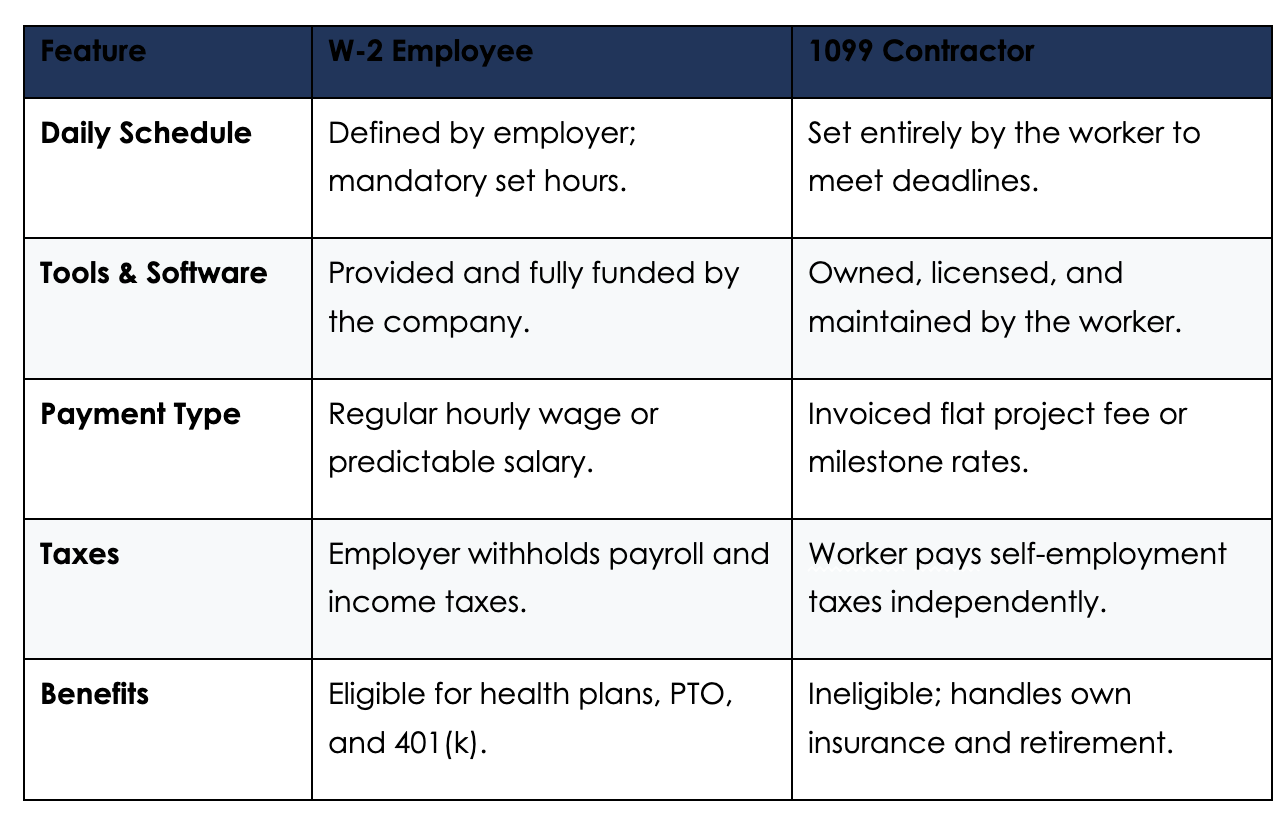
You can use the quick reference table below to spot common differences between an employee relationship and an independent contractor relationship.
Accidental Violations: Red Flags That Trigger Audits
Many compliance mistakes related to 1099 independent contractors occur due to simple operational convenience. Watch out for these high-risk practices that blur legal boundaries:
Mandatory Internal Meetings: Requiring 1099 contractors to participate in regular internal weekly staff standups or culture-building exercises.
Company Email Accounts: Issuing contractors your standard branded company email address (@yourcompany.com) or custom company business cards.
Forced Exclusivity: Restricting a contractor from taking on work from outside businesses or secondary clients.
The Small Business Compliance Action Plan
This guide is intended as general educational information and does not replace legal, tax, or payroll advice. Classification rules can vary by jurisdiction and by the specific facts of the working relationship.
Protect your growing business by using practical compliance workflows for 1099 independent contractors:
Mandate Formal Invoices: Never pay contractors automatically on a standard payroll schedule. Require formal, detailed invoices linked to specific project deliverables before releasing funds.
Verify Business Entities: Prioritize working with independent contractors who operate under an official LLC, S-Corp, or an established DBA (Doing Business As) to confirm independent structure.
Draft Scope-Specific Contracts: Ensure every single independent contractor agreement features an explicit scope of work, defined milestone deliverables, and a clear project termination date.
Get Guidance When in Doubt: If a role falls into a gray area, consider getting professional guidance before deciding how to classify the worker.
Worker classification is more than a paperwork decision—it should reflect the reality of how the work is performed. A thoughtful review of control, financial independence, and the nature of the working relationship can help businesses identify potential misclassification risks before they become costly problems. When the facts are unclear, taking the time to document the relationship and seek professional guidance can be far less expensive than correcting a classification mistake after the fact. The goal is to make sure the classification fits the relationship from the start.